Wuppertal
„It always rains in Wuppertal“. As official city anthem, this sombre instrumental piece is probably not very suitable. Under the pseudonym Pyrolator, Kurt Dalke, member of the groundbreaking experimental band "der Plan", published this track on his 1979 debut album "Inland". Of course, the meteorological insinuation has nothing to do with the fact that about ten years later, the "Wuppertal Institute" for climate, environment and energy was founded in the largest city of the “Bergisches Land”. However, if one combines both facts, one thing becomes clear: Wuppertal has a rather unboastful image, which it really does not deserve. Innovative research is as much at home in the university city as cultural institutions of great importance such as the renowned Von der Heydt Museum as well as the Pina Bausch dance theatre: home of the roots of a revolution that would change dance as an art form worldwide. So please take to heart the fact that Wuppertal amounts to far more than just the overhead railway.
Wolfgang Kienast

Anja Eder
Slats of paper form an organic-seeming Lightsource. Depending on daylight and airstreams, the lamps by Limpalux change their shape and colour, turning a luminary into a swinging sculpture. Functionality meets design. Initially planned as an art ...
Read more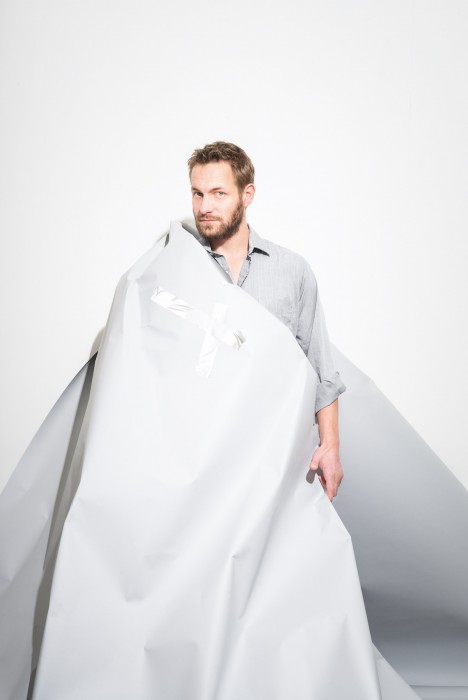
Christian Hampe
Utopiatown – that sound’s great! At any rate, it does not sound like Wuppertal and even less like Mirke, the district in which train station the roots of Utopiatown lie. Christian Hampe is one of ...
Read more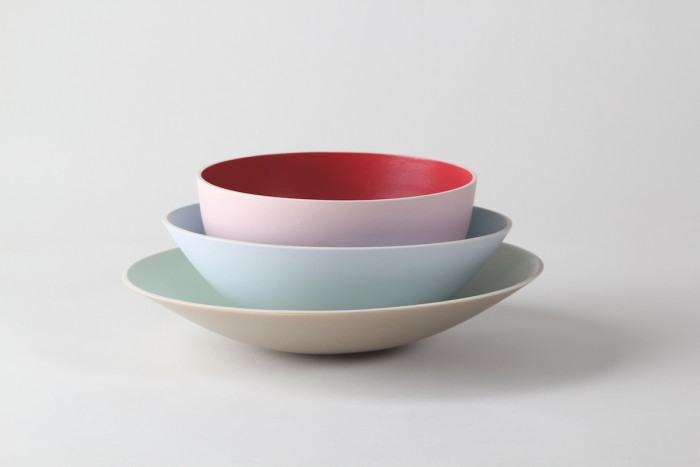


Ruffceramic
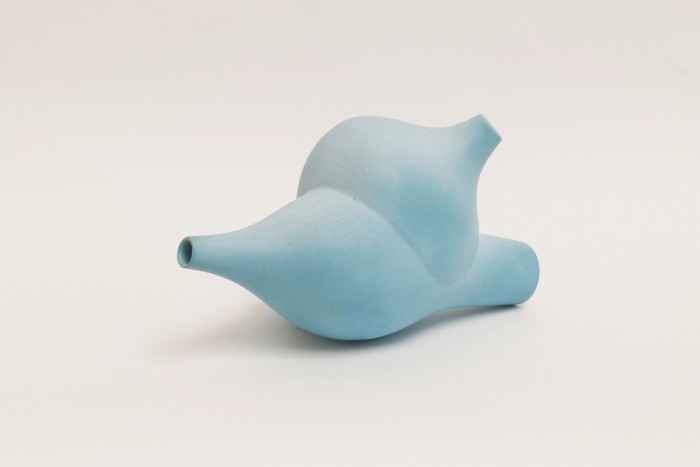
Christine Ruff's studio is located on the fourth floor of a house in Wuppertal's inner city. The view of the surrounding rooftops is certainly not bad, but what captivates the eye, are the meters-high shelves on the walls. Or rather their content. Here, the artist has carefully placed her ceramics, as well as the turned gypsum models from which the moulds are created for her objects. Playing with form is what drives Christine Ruff and what fascinates her in her work. The bigger these are, the more difficult they are to handle, the designer reveals. Anyone looking around the studio and seeing the huge vases can imagine how demanding their production has been. Christine Ruff spent about six months working on the first casting mould when she became self- employed in 2004. For this is the point: nothing but pure form. Simplicity and elegance are the common thread in her collection. She consciously underscores the much-cited design principle of "form follows function" and moves between art and design, spatial object and object of utility. In most cases, a series of multiple objects originate from one sculpture, and their shapes are derived from one another. For example, the next variation of a bowl-vase can be increased or decreased by the extent of the edge. Through these determined parameters, the multiplicity of one arises. One element, for example the pedestal, always remains the same in this process. This sounds very systematic and planned: but the ceramist also draws creative energy from misfortunes and accidents. In the process of removing a bowl from the negative, which was actually planned to be rotationally identical, the latter is deformed. This is an effect which intensifies when heated in the oven. But instead of starting all over again, Christine Ruff used this chance moment and deliberately supported the deformation, creating the series "Schwammerl". The collection of the Wuppertal artist, whose clear and elegant style is in tune with the Zeitgeist, includes belly vases, wobbly bowls, cups and bottle or ball vases, but also wall plates. Remarkable are the pair vases, which complement each other in their form: the belly of the first vase is absorbed by a corresponding concave line in the second. Thus, both objects nestle together wonderfully. Her portfolio also reflects the development of her work. At the start, all her creations were pure white, nowadays mostly one- or two-coloured in pastel tones, but patterns can also be found in her works. "I love to get the best possible results using the simplest methods," she explains - and when painting a cup, you can also use a lace doily or a cotton cloth.
Author: Julian Krings
Fotos: Anja Eder
Hofaue 53
42103
http://www.ruffceramic.de/


Utopiastadt
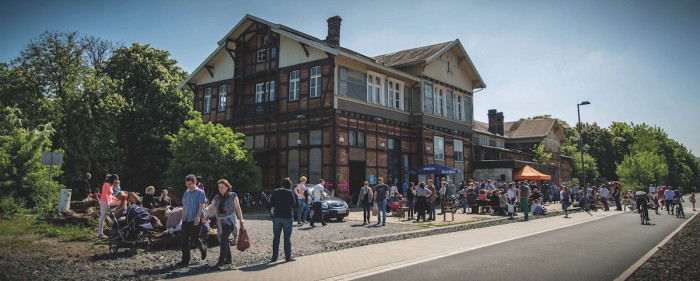
Change begins with small things – it sounds like a platitude, but it is not. In all honesty then: how often do we escape into the excuse that we, as an individual, can not change anything anyway? This is where Utopiastadt in Wuppertal gets in. "We have given our quarter a n ame and a map," says Christian Hampe, who founded Utopiastadt together with Beate Blaschczok. The quarter surrounding Utopiastadt in the old Mirke station, had before simply been known as part of Wuppertal Nordstadt but is now known as the Mirker quarter, thanks to the work of the Utopiastadters. To this end, the two communication designers designed a map showing cafés, pubs, shops and local initiatives in the surrounding. This creates a framework for identification and positioning, and only in this way, it is possible to take responsibility for the quarter. The image of a framework must not be misunderstood - it does not border, but is open. All are invited to participate. Accompanying the name and the map, is a value compass, which is developed and lived by in Utopiastadt. 150 volunteers help children learn how to plant their own vegetables, repair donated bicycles together with refugees or initialise projects for mobility and culture. Utopiastadt offers an infrastructure, space and a network to deal with social issues: a "tabula rasa", where everyone can work together creatively. "We would like to create a sensibility for the little things," says Beate Blaschczok, "for example, not simply throwing away food just because it is two days above the minimum shelf life." People should be convinced of their own self-efficacy. This way, a critical mass can emerge, guiding the process of world transformation in order to make a Utopia of a more just, clean and creative society come true. At least a little bit.
Author: Julian Krings
Fotos: Sven Pacher und Wolf Sondermann
Mirker Str. 48
42105
http://www.utopiastadt.eu/